My birthday started with death threats
Who is welcome in Uganda and who is not.
My 31st birthday started with death threats. The reason, I stood up for LGBT+ rights in a Ugandan WhatsApp group. It was sad but it brought some interesting insights:
Last week, Uganda passed a bill to criminalise homosexual relations. I was in Eastern Uganda during the run-up and passing of the bill. During that time, I saw the local news and public response.
Some reactions almost seemed like tragic satire - people sharing images of bikini-bound women with “fight homosexuality” emblazoned in capital letters. But what stuck me was the stark violence in many messages, and uniformity in hatred.
My Ugandan friend felt the topic was a political tool to distract from other state problems. Perhaps this is so but regardless, the bill legitimised those with homophobic views. They had won. They could be open about their hate. It felt similar to the rise of racism around Brexit.
The large WhatsApp group1 I had been invited to was managed by highly educated Ugandans. When I called out a homophobic post, immediately users retaliated against me, said they would bury me and tried to establish where I was in the country. All from two short messages saying I supported LGBT+ rights.2
The anger was palpable and users seemed shocked by my stance. Importantly, my UK phone number was used to support another argument, that LGBT+ rights are a form of colonialism imposed on Uganda.
Actually, Uganda might have been more accepting of homosexuality before colonialism. Homosexuality was historically recognised by multiple ethnic groups. King Mwanga II was openly bisexual. The Lango people had a third gender who could marry into same sex relationships. This history seems to have been forgotten in modern narratives. Still, the current global push-back to the bill appears to be strengthening this colonial argument.
But why do many Ugandans seem to feel threatened by homosexuality?
Museveni has long been against gay rights, sending a strong political message. I saw religion used as a reason against gay rights - but I also saw a church being open to LGBT+ members.
A colleague of mine once posted a great blog post on the topic which sadly was on a now defunct website. Essentially, some rural Ugandans rely on certain social foundations. One of these pillars is male-female family structures. Same-sex relations pose an alternative to these structures, causing knock-on effects to how communities find stability.
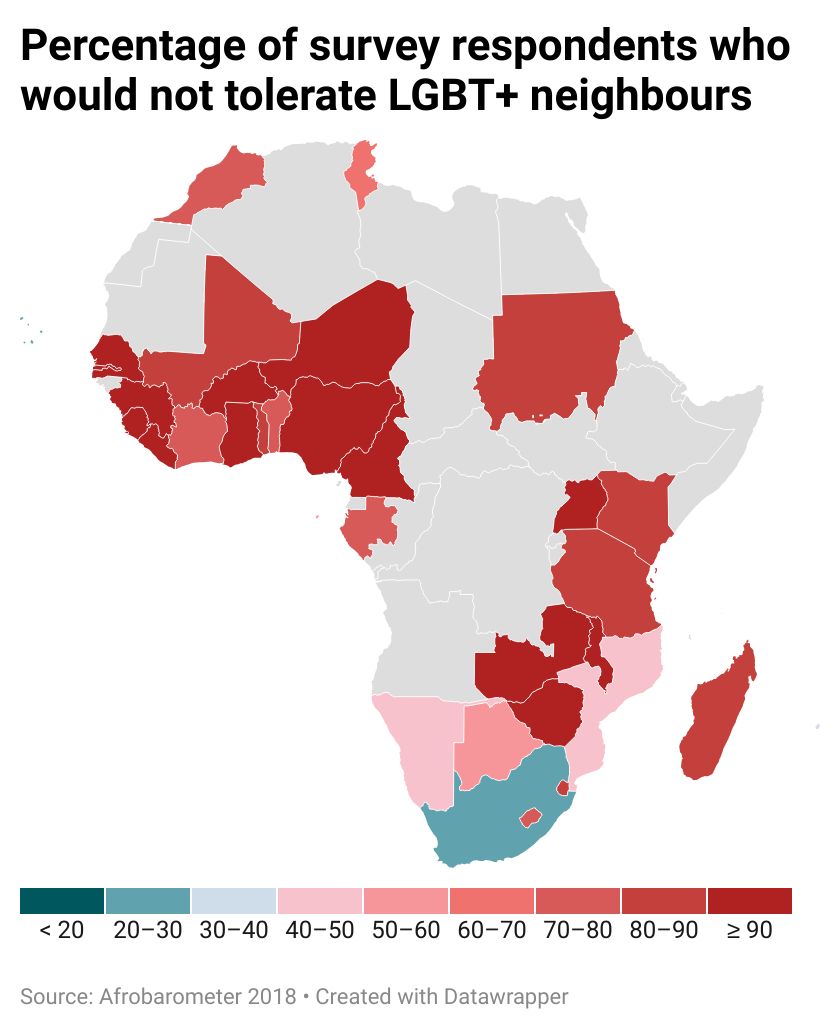
Still, there is something important to highlight. The bill is receiving great pressure to be revoked but it is a symptom of a deeper problem: Ugandan general public intolerance of LGBT+ rights. The bill should be revoked on many grounds, but achieving this doesn’t address this deeper problem and the global pressure will strengthen colonial arguments.
As the graph above shows however, Uganda is not an outlier in these views. As LGBT+ rights struggle across the continent, how can we influence public opinion to make a Uganda and its neighbours a home for all Africans?