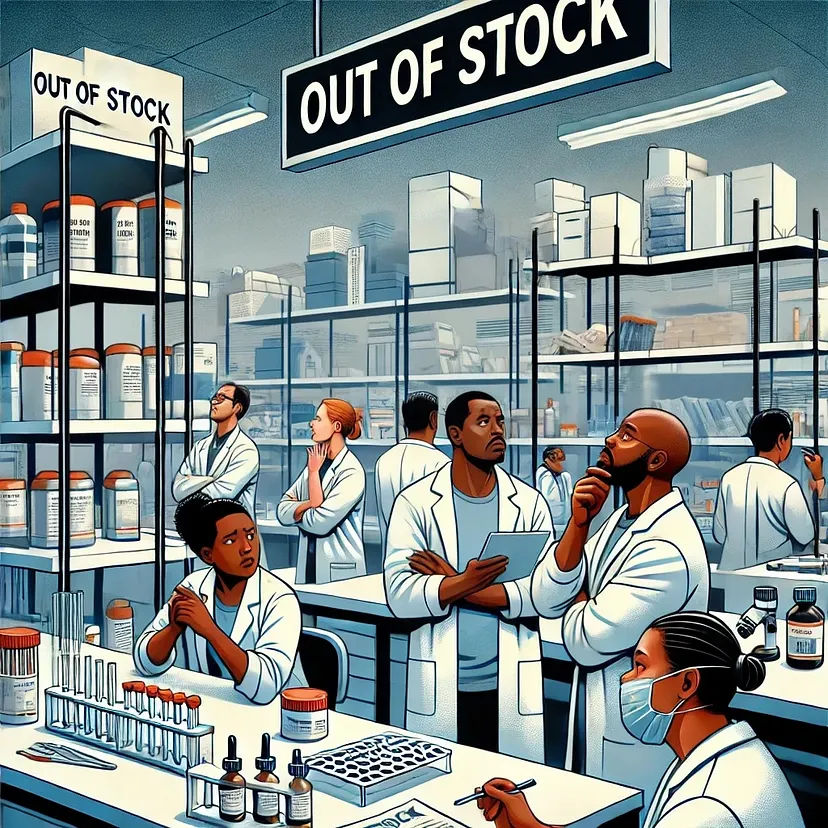
All demand and no supply
A fundamental barrier for African bioscience
The director closed the door and sat across the table from me. After a pause, he sighed and with an earnest look said, ‘can you get us reagents?’
We’d spent the day with a sub-Saharan partner discussing the promise of their biotechnology research for the country’s agriculture. Scientific advances meant we could spot crop diseases faster, quickly identify what made some plants resistant and rapidly breed this resistance into new varieties for smallholders.
It had been an exciting visit. We’d heard big dreams and the local research team buzzed with the potential their work held for the country.
So I expected our private chat with the director to focus on the funding strategy, project targets or implementation plan. But no, clearly there had been that burning question all day in the director’s mind — and one he was embarrassed to ask in front of his staff.
I’ve heard this same question many times and it’s something my friend Oluwaseyi Shorinola and colleagues demonstrate is common across the content.
Essential ingredients for bioscience
Reagents are lab consumables used in chemical reactions or analysis. Think of them as the baking soda in a cake or the chemicals used to develop analogue photo film. Just like these examples for bakeries or photo labs, a bioscience lab runs on reagents. They are common consumables and essential for operations — and here lies part of the problem.
Say you had a bakery and sought funding to make the world’s best cakes. Competition for investment is high, so you lead with your most exciting ideas. Doing anything less is not going to catch the eye of donors. So then imagine if those same investors find out you can’t get baking soda. No investor is going to specifically fund your baking soda shortfall — they want to use funds for more exciting things, like master cakes. You’d have an equipped kitchen with all the staff and no pastries.
I’ve been in African labs that have acquired the latest bioscience equipment from large grants, but lack the $20 chemicals to use them. And it’s not just reagents, but many other fundamental consumables. So why is it that sub-Saharan labs can own lab-based Ferraris, but lack petrol?
A major challenge is that many lab consumables are not made in Africa, which brings added costs. It means purchases are not made through the original producer, but distributors who can charge over double the price. Labs I worked with were also not sure of what the original should cost, hindering their ability to know a fair price. This separation from the original producer also prevented them from negotiating discounts on ongoing purchases — if you’re a small lab, you’ll pay more than a wealthy lab. But the challenge doesn’t just end at purchase.
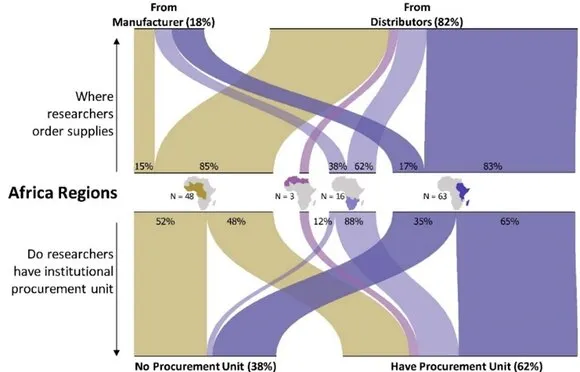
Delivery then brings more challenges. Shipping prices are astonishingly high and further costs (and delays) are brought in customs clearing. For example, Ghana has around eleven duty fees on goods in addition to customs tariffs and VAT. These stages not only raise costs, they bring risks. Some reagents rely on cold chain storage and perish within days at room temperature. You can pay a fortune to import useless products.
Right now there are researchers travelling with hold bags full of reagents and consumables in a desperate attempt to restock collaborators.
The problem is compounded by many research grants providing procurement of equipment, but there being little in the way of ongoing support for sustained access to the required reagents. It’s how a small lab can have a high-tech sequencing machine for cutting edge research, but little funding to sustainably use it.1
Because of these challenges, many smaller labs take opportunities to stockpile reagents, facing a choice of perishing consumables, or equipment that gathers dust. Such supply barriers also make smaller labs face greater delays, fall behind on research plans, and struggle to deliver intended impacts within the grant lifetime. This has knock-on effects to partnerships and funding renewal.
It also takes enormous amounts of time, usually at the cost of taking researchers away from their work.
These supply challenges are not new but sadly very little progress has been made over the last decade to amend them. That’s why right now there will be researchers travelling with hold bags full of reagents and consumables in an attempt to restock sub-Saharan collaborators. This is not a solution but an act of desperation.
Ultimately these barriers can encourage promising African research talent to leave the continent, and struggle to justify returning. Just like these lab consumables, it’s hard for these future leaders to find a viable path to sub-Saharan labs.
What needs to be done
We must take steps to overcome these challenges if African bioscience is to realise its full potential. The good news is that change is possible. We need:
- To raise awareness of this challenge, so labs feel able to speak openly about the barriers they face.
- To increase transparency between producers and African suppliers to equip labs with the information to negotiate fair prices.
- Donors to consider the legacy of funding if promising labs are to achieve sustained impact.
- African governments to provide tax exemption and streamlining for scientific shipments intended for education and national research.
- Labs to share success stories and examples of best practice for research procurement to guide others.
Fundamentally, we need to address his challenge through transparency, collaboration and advocacy. Solutions do exist, but these are seldom well documented or widely know.
Those of us working in this space, I invite you to share both challenges and solutions more openly. Through ensuring that all labs can access basic lab essentials, we can unlock enormous potential across sub-Saharan bioscience.
— — —
-
This means that it’s often better to purchase more basic equipment, since it can run on locally available consumables and maintenance. ↩