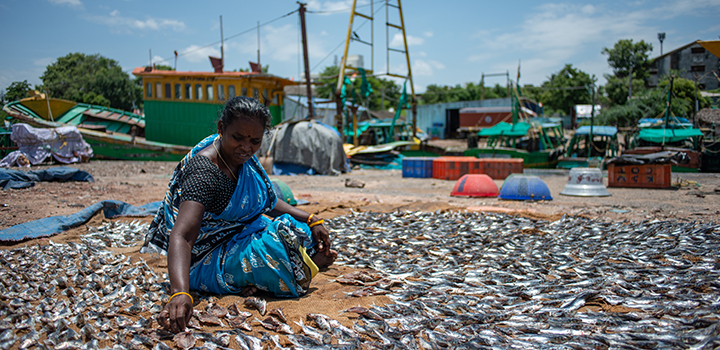
New systematic review on fish processing and gender
Women who work in the fisheries industry are being left behind
Our systematic review is out in Nature Food on the social sides of aquatic post-harvest hashtag#processing. Here’s a story from the ‘sex for fish’ practice in Ghana showing the importance:
Many women in Ghanaian fishing communities have to offer sex in exchange for fish from fishermen 🎣The challenge arises as men are the fishers and women are unable to afford fish to sell.
Clearly this is worrying as women who exchange sex for fish are more likely to experience emotional abuse, have unplanned pregnancies or contract sexually transmitted diseases.
The obvious move to protect women would be to ban the practice, but that’s unlikely to prevent it. The reason it exists is because vulnerable women lack the agency to choose otherwise.
So the Ghanaian National Fish Processors and Traders Association (NFPTA -https://www.nafpta.org/) took steps to (1) understand the social drivers of the problem and (2) prevent these drivers.
NFPTA worked with women fish sellers, to learn what led them to making these risky choices. Unsurprisingly, the poor are more likely to engage in sex for fish - but there was a feedback loop.
Fish quickly spoils, forcing women to lose products and have to continually acquire new fish. So NFPTA provided training on post-harvest processing methods. Extending the shelf life of fish, reduced the pressure to immediately sell (crucial if you also have household demands).
But why didn’t these women do this before? Because post-harvest processing requires money that many independent women didn’t have. So NFPTA formed women fish-seller groups, so they could access group loans for processing equipment. This meant they could preserve fish, increasing options to sell, and more flexibility on time.
In this way, NFPTA have stopped sex for fish in their groups. The point is that there are social dimensions to post-harvest processing - beyond just reducing food waste (also important).
But this food processing is not all good news. In our review, we find:
- Persistent gender inequality that negatively impacts the health and livelihoods of women. These pressures are compounded by age, ethnicity and migrant status.
- Diverse technologies lead to diverse outputs. Traditional technologies might offer greater flexibility but lower returns. Conversely, factory-based technologies bring stable income, but also health risks and greater gendered divisions.
When post-processing of aquatic foods is done right, it can have great returns across hashtag#nutritional and hashtag#social hashtag#justice dimensions. We call for more research in this area, to find approaches that support all members of the workforce 🙋♀️
Thank you to Nitya Rao Lee Hooper Heather Gray Johanna Forster Julie Bremner Ghezal Sabir Nisha Marwaha Abraham Wanyama Liangzi Zhang, Ph.D. University of East Anglia UEA DEV Norwich Institute for Sustainable Development Cefas