A global system to protect farmers from a persistent threat
Introducing the Wheat Disease Early Warning Advisory System
It is great to be at Njoro with researchers from 23 organisations collaborating to make a global system to protect farmers from a persistent threat.
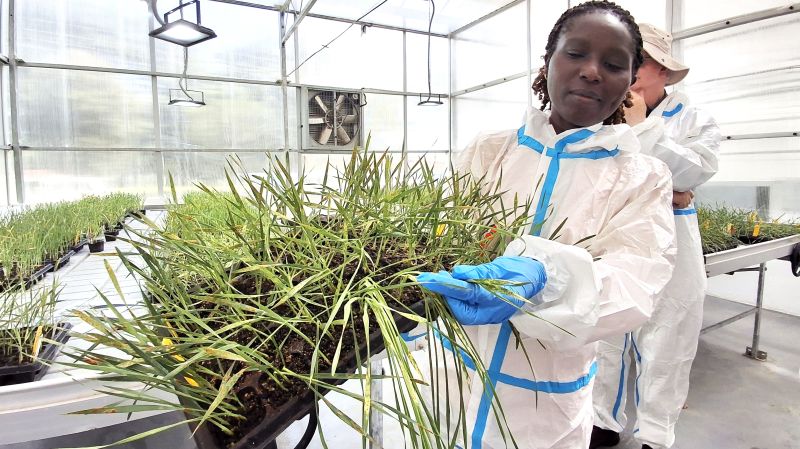
We’re wearing protective clothes in the image because because Dr Zennah Kosgey is showing wheat infected with rust.
Fungal rust diseases cause annual losses to wheat harvests threatening food security and farmers’ livelihoods. Annual losses from rusts cost around $ 4-5.0bn and efforts to control rusts formed a foundation of the Green Revolution.
A challenge with rusts is that they can swiftly emerge and spread. A single rust spore can travel thousands of miles. Rusts can be controlled by spraying fungicides, but these are environmentally damaging and expensive for farmers.
Our best defence is to grow resistant varieties, which mean that farmers are protected without spraying, and less sick plants means less spores to increase spread.
But another challenge from rusts is that they can rapidly change, threatening previously resistant varieties. This makes a constant race to find new rust strains and control them before they spread - ideally through finding new resistant varieties to share with farmers. Missing new strains means that they can cause more widespread damage.
So we need a way to monitor farmers’ fields to catch these new strains 🕵️ but there’s no international plan to make such a rust surveillance system. Instead, the research community rallied to create a system, now known as the Wheat Disease Early Warning Advisory System (DEWAS).
DEWAS is an impressive global collaboration of 23 partners to create one of the world’s largest and most advanced crop pathogen surveillance systems, linking labs with modelling, crop breeding and farmer extension.
Here’s an example of how this network can work:
1️⃣ The Nepal Agriculture Research Council team suspected they found a new rust race
2️⃣ This was confirmed as the Ug99 race by partners in Aarhus University, the first stem rust in Nepal
3️⃣ Modellers at University of Cambridge then saw Bhutan was also risk at risk of stem rust
4️⃣ Bhutan researchers at the National Plant Protection Centre in response found early stem rust incidence, buying time for control strategies to protect farmers
5️⃣ and MARPLE Diagnostics from John Innes Centre means partners can now identify rust races directly from the field site
And there are more partners, with both technologies and approaches improving all the time. The questions now are how this system will grow, and how others can learn from this.
Thanks to Kenya Agricultural and Livestock Research Organization (KALRO) for having us. DEWAS is led by the CIMMYT and funded by Gates Foundation and Foreign, Commonwealth and Development Office - Research, Science and Technology.