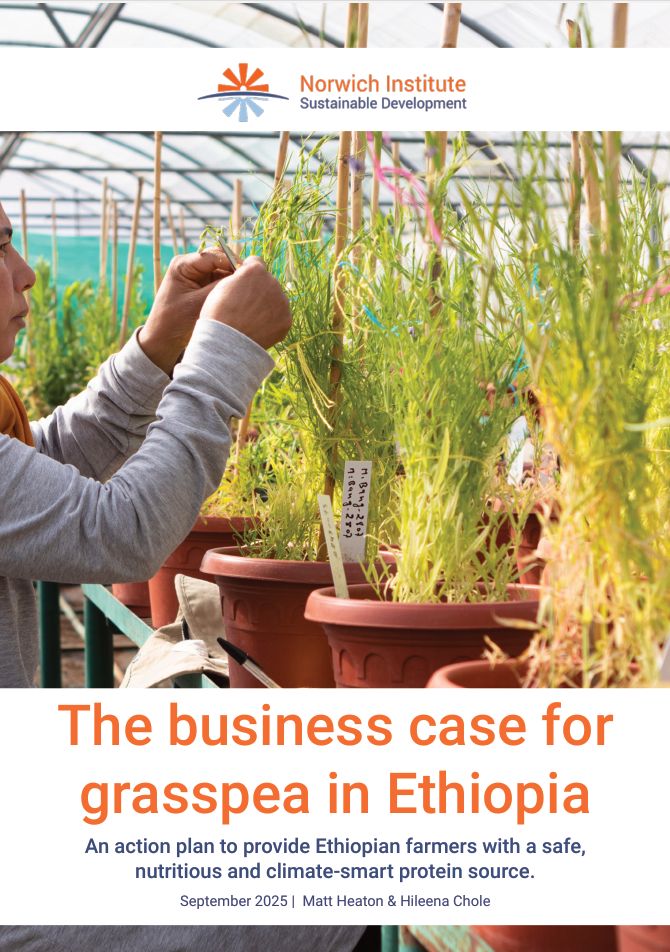
The business case for safer grasspea in Ethiopia
New action plan for a safe, nutritious and resilient crop.
I’m delighted to release our new strategy for the widespread and sustained adoption of improved grasspea for safe, resilient, nutritious and climate smart agriculture - and hopefully a nice approach for other opportunity crops.1
Grasspea cultivation is rapidly increasing across Ethiopia, rivalling other popular legumes such as chickpea and lentils - and it’s clear why. The crop survives droughts and floods, is resistant to pests and diseases, yields on few inputs, improves soil nitrogen content, has impressively high protein content and (perhaps most importantly) consumers like its taste and cooking qualities.
But there is some urgency to replace current Ethiopian grasspea varieties with improved ones. Currently, farmers grow varieties that can contain potentially dangerous amounts of a toxin that can risk irreversible paralysis from the legs down when consumed in large quantities. What’s more, our earlier research showed that farmers have limited understanding of this risk, or how to reduce it.
Improved grasspea varieties have much lower toxin qualities, making them safer. So the aim now is to quickly encourage widespread uptake of these varieties, to replace more risky ones.
But achieving widespread deployment and adoption of breeding-improved indigenous crops can challenging/
In this strategy, based on successive years of research with Norwich Institute for Sustainable Development and John Innes Centre, we outline three methods to sustainably deliver improved varieties to Ethiopian farmers. These include:
🏛️ A government supported approach
🧑🌾 An integrated seed system approach
📈 A phased government- integrated approach
We are now working to commence one of these approaches - more on that soon…
And while grasspea is the focus here, I’m hoping the lessons from this approach can form deployment models for other opportunity crops which undergo breeding efforts.
Huge thanks to my inspiring co-author Hileena Eshetu Chole, and excellent feedback from Arjan Verschoor, Peter Emmrich and Marijke Zonnenberg.
This work is heavily informed by many projects, events and discussions with UEA DEV, ICARDA; International Center for Agricultural Research in the Dry Areas, Crop Trust, Ethiopian Seed Partnership (ESP), Fernand Lambein Fund, Ethiopian Institute of Agricultural Research and The James Hutton Institute. Thank you to all!
-
Opportunity crops here refer to neglected and / or underutilised crops (sometimes called orphan crops) that have received little breeding attention, but have huge potential for more resilient, nutritious, diverse and sustainable agriculture. ↩