Linking farmers with national genebanks for rapid resilience
Introducing 'Germplasm User Groups' as a way to support food security and livelihoods.
Delighted to announce our publication on how national genebanks are an overlooked but important resource to rapidly support smallholder climate adaptation and resilience
“Unlocking farmer access to genebank collections offers a highly efficient way for public investment to support local resilience” Heaton et al. 2025.
Genebanks are essential for conserving crop diversity despite changing farming practices and climate change. While international genebanks often take the spotlight, national genebanks hold unique collections of crops adapted to local environments, diets and tradition - including indigenous varieties overlooked by mainstream breeding, yet vital for nutrition and cultural heritage
With increasing pressure to shift towards more biodiverse habitats and diets for human and planetary health, our paper shares a cost-effective solution, which supports some of the most vulnerable to climate change.
This paper in is a story about empowerment of local actors for the reclamation of hardy, nutritious cultural-heritage crops for farmer resilience.
Our study of 1600 farmers across five African countries finds that developing ‘Germplasm User Groups’ between farmers and national genebanks provided a rapid system to deploy useful diversity to build resilience
GUG members:
🌱 Understand the role and value of genebanks
💡 Had greater interest in crop diversity conservation and use
🫘 Increased crop diversity use
📈 Reported improved resilience and greater yields
🎉 Celebrated reclaiming heritage varieties they thought were lost
Importantly, connecting farmers with crop diversity helped them find their own diverse solutions to their individual needs - and when they find useful varieties, they share them on average with four other farmers, multiplying the impact.
These same farmer-genebank connections also raise the likelihood of conserving more locally-valued varieties, and aid ongoing understanding of farmer needs to feed into resilience and crop improvement efforts.
By connecting directly with smallholders, national genebanks offer a treasure trove of locally adapted varieties that could strengthen agricultural resilience faster than most conventional breeding programmes.
Excellent to share this important work led by Crop Trust, supported by KfW, published in Plant Genetic Resources as part of their special issue on genebanks.
Huge thanks to Nelissa Jamora for being an amazing colleague throughout this research. This study was possible thanks to the huge efforts of an excellent team of early career researchers as part of impact fellowships provided by Crop Trust - so it’s also great also to see the difference this opportunity made for the researchers involved:
“The fellowship immersed me in a research environment where I was equipped with both the theoretical frameworks and practical skills needed to assess impacts. Working directly with farmers changed how I see agricultural resilience.” Tobias Recha.
Huge thank you to the national genebanks leading these germplasm user groups:
🇪🇹 Ethiopian Biodiversity Institute
🇬🇭 CSIR-Plant Genetic Resources Research Institute
🇰🇪 Genetic Resources Research Institute at the Kenya Agricultural and Livestock Research Organization (KALRO)
🇳🇬 National Centre for Genetic Resources and Biotechnology ( NACGRAB)
🇿🇲 National Plant Genetic Resources Centre at the Zambia Agriculture Research Institute
Thank you to University of East Anglia covering the open access costs, and Norwich Institute for Sustainable Development and UEA DEV for supporting me.
Read the paper “Unlocking genebanks for farmer resilience: Assessing the impact of ‘Germplasm User Groups’ in enhancing farmers’ access to diversity”
Read the full story by Crop Trust
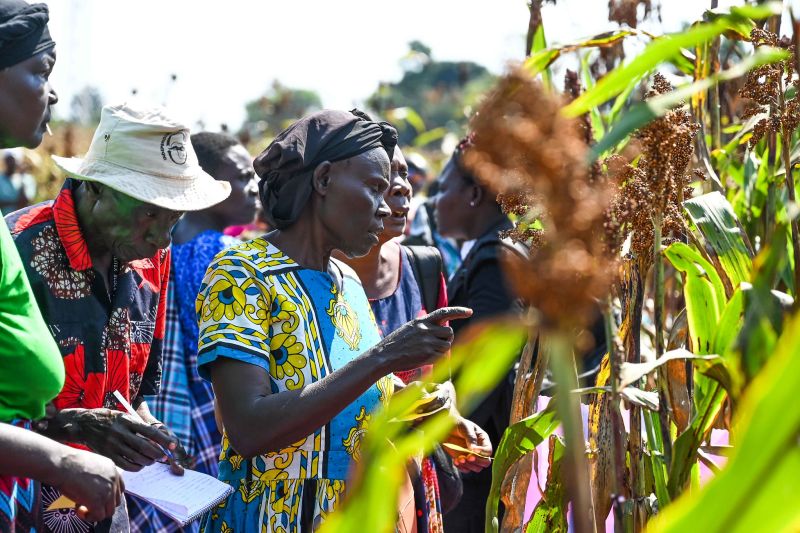
Photo credit: Farmers reviewing sorghum, Kenya. © Crop Trust