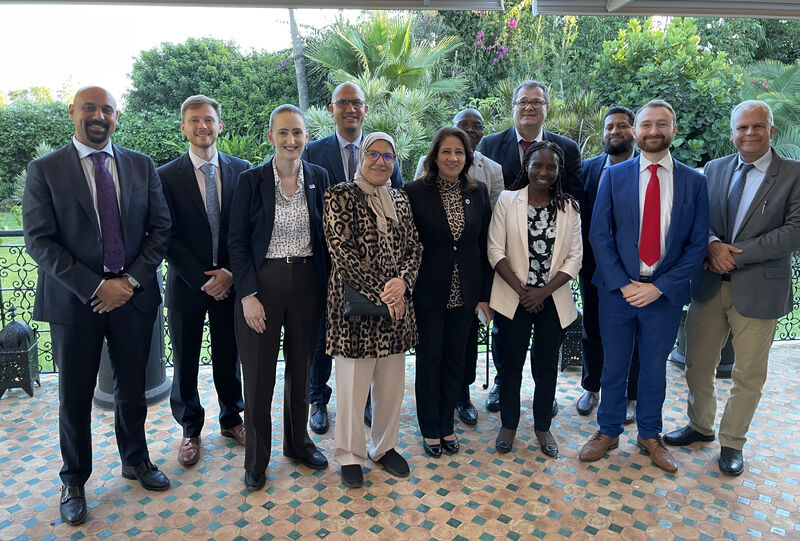
Moroccan precision breeding meeting with British Embassy
Sharing evidence from research with regulators and policy makers.
It was fantastic to chair a meeting at the British Embassy Morocco Ambassador’s residence, for a mutual learning session between five countries on precision breeding. This event underscored the huge potential from precision breeding in agriculture and was a good reminder of the need for close working.
Precision breeding allows targeted improvements to crop genetics that can be used to develop more productive, nutritious, resilient and sustainable varieties. These changes are identical to those that could occur through natural variation or conventional breeding.
Many countries are revising their regulations to recognise precision-bred crops. For instance, Kenya created guidelines for precision breeding in 2022, and the UK implemented the Precision Breeding Act just recently (November 2025).
As part of the UK-CGIAR Centre, we brought together researchers from across Egypt, Kenya, Morocco, Pakistan and the United Kingdom to share their expertise and regulatory updates to help learn from one another. This included :
🔬 An overview of the science underpinning precision breeding by Prof Diane Saunders OBE from John Innes Centre. 🇲🇦 An update of precision breeding research taking place at Institut National de la Recherche Agronomique (Maroc) from Iraqi Driss, PhD 🇪🇬 Egypt policy developments from Prof Shireen Assam and Ahmed Elkot of Agricultural Research Center - Egypt 🇰🇪 Kenya policy developments from Dr Zennah Kosgey of Kenya Agricultural and Livestock Research Organization (KALRO) 🇵🇰 Pakistan policy developments Dr Awais Rasheed of Quaid-i-Azam University, Islamabad 🌍 Many key insights from director of ICARDA; International Center for Agricultural Research in the Dry Areas Biodiversity and Crop Improvement Program Dr Michael Baum. 🧑🔬 Further science updates from Dr Ntui Valentine of UM6P - University Mohammed VI Polytechnic 👋 And facilitated by me from Norwich Institute for Sustainable Development and UEA DEV.
Which made for a fantastic range of experiences to feed into this mutual policy learning event - and a joy to work with teams like this.
Huge thanks for British Ambassador in Morocco Alex Pinfield OBE for joining us and kindly hosting us at his residence. Thank you also to Ahmed Himy for all his support and insight throughout. It was fantastic to work with the British Embassy to host this timely dialogue.
Big thanks to Dr Anna Backhaus and Dr Maximillian Jones for some inspirational project management throughout, making all of this possible! Lots of great ideas here and more to share in the future
The UK-CGIAR Centre is managed by CABI and supported by the Foreign, Commonwealth and Development Office - Research, Science and Technology.