The average height of UK 5-year olds is decreasing
Mirroring other European countries.
Being tall as a child is generally a good thing. Taller children tend to have better physical and mental development, higher educational attainment and greater salary prospects. That’s not to say that shorter children can’t achieve these things too, but at a population level, their chances are lower.
Clearly it is not ‘being tall’ that makes one perform well. Height is an indicator that an individual’s development was not constrained by their diet. There are genetic reasons why we eventually reach different heights, but diet determines whether we achieve our full growth potential.
For example, stunting remains a problem where children are under-nourished, and this has knock-on lifelong impacts. These children may have the genetics to grow taller, but their restricted nutritional intake prevents them from reaching these heights.
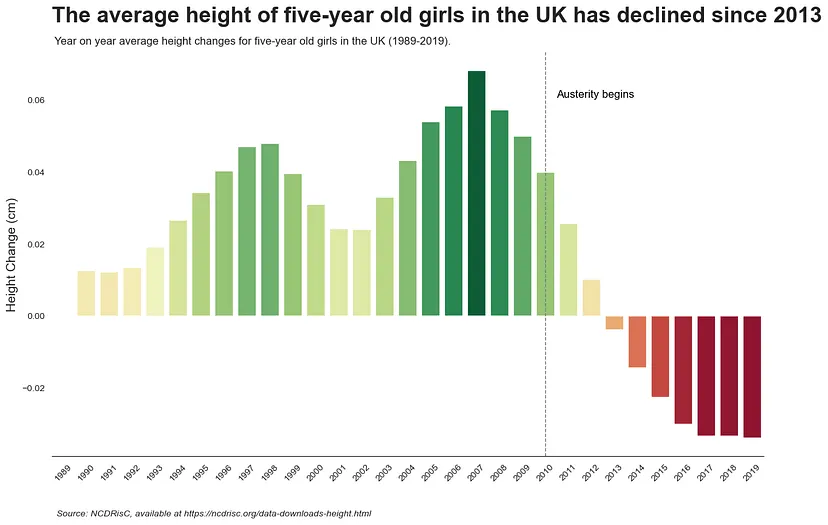
So average childhood height is a key indicator for governments planning to improve the welfare of their populations. This is also the reason that many in the UK are concerned to see that the average height of a five-year old has been decreasing since 2013.
In the graph below, I’ve re-made the graphic demonstrating this in a recent report by The Food Foundation, ‘A Neglected Generation’. I’ve made an addition of a marker for when UK austerity measures[^1] came into effect, which I’ve included due to the following quote from the report:
“[Declining average height of five-year olds] has coincided with the introduction of austerity measures pointing to a possible explanation.” A Neglected Generation, The Food Foundation, Page 4.
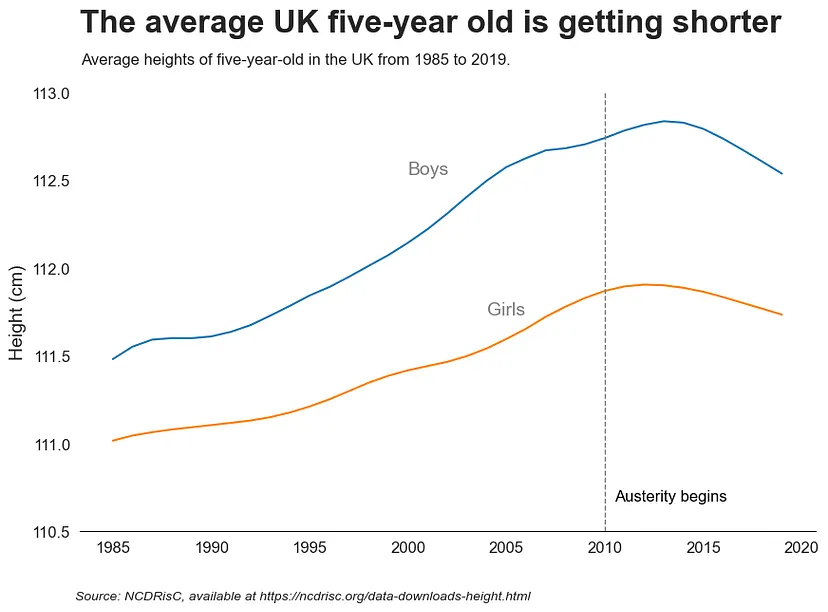
As we can see, the trend in average heights is decreasing, and this pattern appears to be similar for boys and girls. We can also see how this change coincides with the timing of austerity measures — we’ll come back to this.
One thing to note is that the y axis of this graph could be misleading. While the pattern of the graph is alarming, these are fairly modest changes in height. Most of these year on year changes are around two millimetres in height. Still, something this graph doesn’t clearly show is the rate at which this change is taking place.
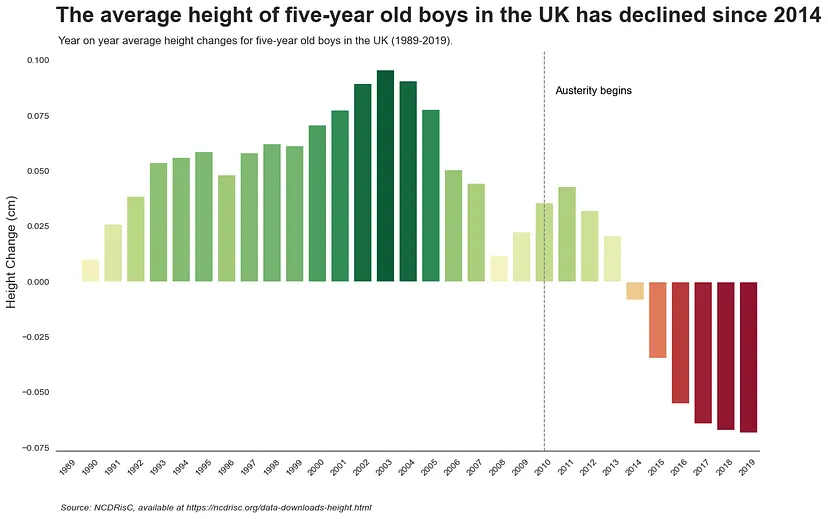
In the graphs below, I’ve shown these as these change in average height from each previous year. Here it is for boys.
And for girls:
Again, while this shows that yearly changes are quite small, the rate of the year on year decrease is quite rapid post 2013, and remains consistently so. The average height of five-year olds is decreasing, and this is mostly happening by a larger amount each year.
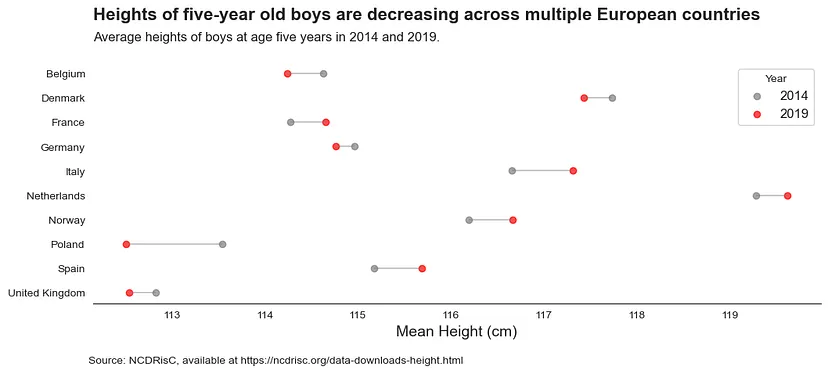
And this reduction in average five-year old height is particularly concerning, because UK children are already smaller than many surrounding European countries. In the graphs below, we can see these changes in average five-year old height across the UK and ten other European countries.
Here we have boys.
The same is also the case for girls.
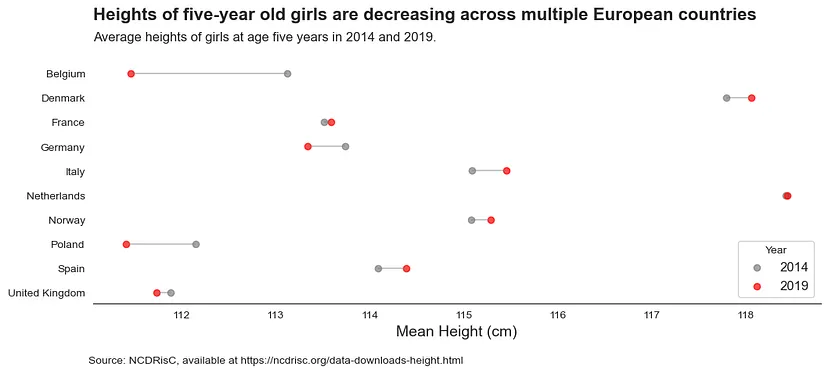
As we can see, UK children are on the smaller side compared to other countries nearby. This could perhaps make it more concerning that average five-year old heights are becoming comparatively even smaller.
But what these graphs also show is that it is not just the UK that is seeing a fall in the average height of five-year olds, and these decreases are much larger in other locations.
This is something that doesn’t come out in The Food Foundation report. An initial reading of the report could suggest that the situation of reducing average child heights in the UK is particularly bad. Actually, a concerning finding is that these trends are happening over a number of relatively globally wealthy countries, and to a greater degree.
This brings us back to UK austerity measures. We know that UK austerity measures led to cuts in support services related to the health and development of children. These changes in average five-year old height could therefore be indicators of the impact of these cuts, and echo other reports of declining health in UK children.
But the UK was not the only country to go through austerity measures. France, Italy, the Netherlands and Spain all did, and yet they show a rise in average heights of five-year olds over a similar period. In fact, Italy saw one of the larger jumps in the average heights of five-year olds.
And the real surprise here is Poland. Poland was unique among EU countries as the only member state to avoid a recession during the 2008 financial crisis. Instead its economy grew during the same period. In fact, Poland even increased public investment, supporting businesses, and implementing tax cuts to encourage spending and investment. Yet despite increased public spending, the average height of a Polish five-year old has seen one of the larger reductions, to now being one the smallest groups.
So yes, austerity-related cuts to public services will have affected the families that rely on them, but the picture of childhood nutrition is more complex. In some places of public cuts, the average height of a five-year old is still rising. Conversely, increased public spending does not automatically associate with taller children.
We need to understand why patterns of childhood under-nutrition are arising across European countries, and we need policies that learn from those countries that appear to be succeeding in this area. Doing so is essential to safeguard the well-being of our youngest generations to ensure they reach their full potential.