How do young people see food and sustainability?
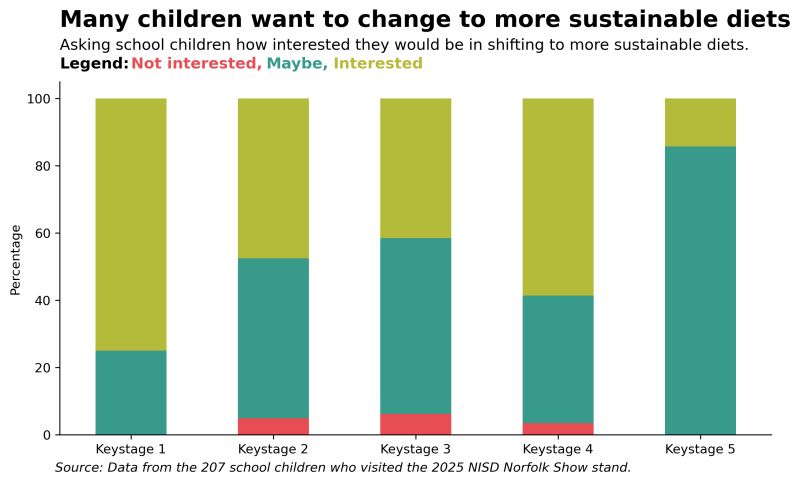
Asking school children how interested they would be in shifting to sustainable diets.
Younger people have more of the future ahead of them and so will be more affected by the sustainability choices we make today. Yet these same groups are often left out of sustainability conversations and decision-making. Perhaps unsurprisingly then, there are increasing reports of younger generations feeling powerless to make changes for a better future, with growing numbers reportedly suffering from climate anxiety.
The NISD therefore took the opportunity of the 2025 Norfolk Show to listen to young people, to hear their views about the environment, food education and how willing they would be to change to more sustainable diets.
The following graphs and thoughts are taken from interacting with just over 200 children who visited the NISD stand at the much larger Norfolk Show ‘Discovery Zone’, a STEMM learning space. The event took place over two working days, with over 1500 children visiting the show, many joining as day trips from surrounding schools. We spoke to attending young people between the ages of five to eighteen.
There are of course biases with speaking to children about food while based at an agricultural fair – in a county known for agriculture – which could restrict how representative our findings are of UK children more generally. With that said, the visiting children came from a range of backgrounds, with few directly involved in agriculture. We therefore offer a quick snapshot of how Norfolk young people felt about the environment, food and sustainability.
How often young people think of the environment?
This blog started with the narrative that young people think regularly about the natural world and its preservation. This is therefore the first assumption we wanted to check, whether young people think regularly about the environment, and to see if this varied across key stage education levels.
We find that many young people reported to regularly think about the environment, but that this frequency appeared to reduce as children reached later teenage years. Younger key stage groups were more likely to report thinking daily of the environment, while the majority of older teenagers reported rarely thinking of the environment.

This “thinking about the environment” was deliberately left open for interpretation and discussion. Many understood this pragmatically as taking environmental action, while some viewed this more abstractly as simply thinking about the natural world around them. In most cases, the environment was seen as a beneficial, vulnerable and wondrous space.
It is unclear why thinking about the environment might change with adolescence, and no respondents reported noticing this change in themselves.
Some potential reasons for changing views from conversations were that younger individuals spent more time in natural spaces, such as visits to the park, woods or sea. These experiences seemed to make individuals feel closer to nature. It is these experiences that might explain why when younger children were asked how to protect the planet, they were more likely to speak about stopping littering or planting trees – tangible actions that affect the wild spaces they were exposed to.
Older teenagers on the other hand seemed to have more time demands from school and social activities, which could require more attention in their every day lives. The majority of adolescents we met still valued the natural world in their answers, but appeared less engaged with nature on a daily basis. Teenagers were however also more likely to suggest measures to protect the environment that tackled larger more societal changes, such as decarbonisation and moving towards plant-based diets.
Overall, we found that young people generally care deeply about nature, but the prominence in mind and experience of nature subsided as individuals moved into later teenage years.
Many young people would like to see more education on food
Another common narrative is that the many members of the UK public are unsure about where their food comes from and how it is produced. This same lack of understanding can mean individuals might make make less healthy or sustainable meal choices. UK schools also have an absence of education around food. We wanted to understand from young people if education on food would be something they are interested seeing more of.

We posed the question to children of how they would feel if their school planned to introduce more classes on food and food production. We find that many children would welcome more education on food, although the slight majority were more open minded than excited.
Those who were excited saw learning about food as interesting in its own right, and knowledge that they could use to make more informed choices for their diets. Many however were less clear on what this food education might look like, the value it offered or what it might be in place of. Despite some uncertainty on this topic, very few individuals pushed back on the idea of more education around food in school.
Adult farmers who visited the stand were consistently supportive of more education about food produce, seeing this as a way to raise awareness to source more ethical and sustainable food, which they associated as UK produce. Often these conversations focused on reducing food miles, or appreciating to the animal welfare standards of UK livestock. In these narratives, school education on food took on a more nationalist agenda as one that championed the perceived higher standards of British food production over imported food. These arguments also took on a sustainability lens, which touched on our final question.
Many young people would like to change to a more environmental diet
Food systems are a major contributor to carbon emissions and resource use. Subsequently, changing diets to more sustainable foods offers one of the most effective ways for individuals, and societies, to reduce their carbon footprint. Eating a more sustainable diet in the UK would also mean a more healthy diet.
We wanted to understand how children linked food to sustainability topics, and whether they would be interested in changing diets to more sustainable choices.

We find that many children are interested in shifting to more sustainable diets, and more so than previous data on UK adults.
Most young people were willing but either felt unsure about which foods are more sustainable, or were reluctant to give up particular favourite foods – regularly cited as chocolate. Chocolate was suspected to be an environmentally high-impact food by even those who stated not to know the environmental costs of different foods.
Despite jokes about reluctance to give up favourite foods, very few individuals reported to be uninterested in changing to more sustainable diets. This suggests that most people were open to the idea in theory, but wanted to know more about what this meant in practice. Older teenagers were the least likely to be motived to change their diet, despite likely having greater control of their diet than the younger age groups who rely on adults.
Beyond chocolate, understanding was limited around the resource requirements for different food products, with people being unsure about where the costs come from in food production, and how this differs between products.
Young people and adults saw food miles as the main sustainability concern, despite the reality that the production costs of food products almost always outweighing shipping costs. Only a handful of teenage girls identified livestock, particularly beef, as having a higher carbon footprint. Several adults however mentioned reducing beef consumption and shifting to white meats instead, such as chicken.
Supporting young people to make informed choices
Our snapshot therefore suggests that many of the young people we spoke to want to change to more sustainable diets, aligning with the interest many young people have in the natural world and its preservation. Individuals are however unsure what this dietary change might look like in practice, but we also find many would welcome more education on food.
These findings suggest that connecting schools with more food education could support the interests of young people, and help them make more informed choices about the food they eat. Doing so might build a greater sense of agency in younger people for the food changes they want to see in the world, and raise the likelihood of better diets for people and planet.
Thank you to Dr Samantha Fox and the Norfolk Show Discovery Zone team for welcoming the NISD team to attend the event.
Blog originally on NISD