Avoiding AI to save water? Change your diet first
Changing diets tends to have much greater potential to save water.
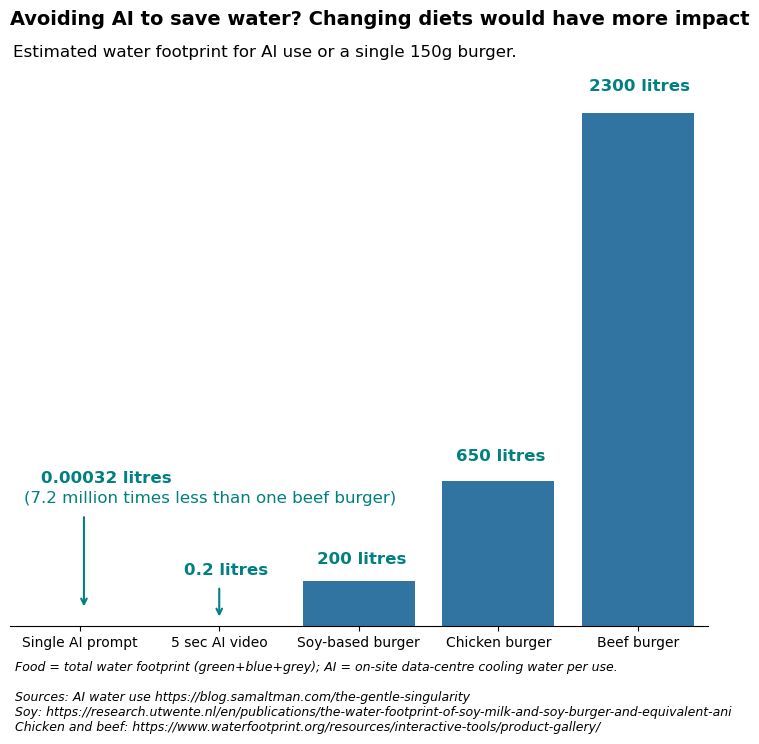
I’ve seen lots recently on avoiding AI use to reduce water consumption - fair enough, but it seems dietary change would be more effective. A quick breakdown:
First thing to note, the figure I made above is based on estimates and averages and simple calculations,1 but the general direction seems consistent.
For instance: prompts vary in resource requirements; water security concerns vary depending on the context rather than just an absolute number (dryer or wetter places, politics, etc.). To note also, I’m using a combined green, blue and grey water values to give total water footprint.
I’ll happily update the graph below if someone has better estimates but I suspect the pattern will be similar.
In short: Yes, there are water concerns with AI use, but these operational costs are in the scale of hundreds of thousands to millions of times less water requirements than a single standard beef burger.
That’s not to say we shouldn’t be concerned about resource costs of AI, but to contextualise that these water demands are much smaller than common food choices.
But of course, this graph just shows values for AI operations when many are concerned about the larger water footprint required for the associated data centres - so how does this total footprint compare to beef?
Let’s go bigger than just AI. The International Energy Agency (IEA) estimated last year that the data centre sector (all data centres, AI and beyond) consumes 560 billion litres/year of water.2 For clarity AI accounts for around 15% of this total data centre electricity demand.
Now let’s estimate some values for the total water footprint of global beef production. Mekonnen & Hoekstra3 estimate that the beef cattle sector accounts for 7.98×10¹⁴ litres/year per year of water footprint. Or we could use the FAO global beef figures (76.6 million tonnes in 2023) and multiply that by the global average beef water requirements (15,415 litre/kg)4 and we get 1.181×10¹⁵ litres/year total.
Which gives us a ballpark for global beef production requiring 798 trillion to 1.18 quadrillion litres of water per year.
So we can estimate that beef production alone uses somewhere between x1400 to x2100 the water footprint of the entire global data centre footprint - And that’s just beef, not including dairy or the wider livestock figure.
Again, these are quick estimates from what I could find but in summary: yes, we should refrain from overuse of AI on water security grounds, but if you’re looking to save water, transformative improvements will come from prioritising dietary changes.
This post was originally on LinkedIn and led to some nice debate in the comments.
-
e.g. 15% of the litres per kilogram values at the following link to give an estimate for a 150g burger ↩
-
The carbon and water footprints of data centers and what this could mean for artificial intelligence ↩
-
A Global Assessment of the Water Footprint of Farm Animal Products ↩